

The Hidden Cost of the ‘Promotions’ Folder for Home Service Contractors
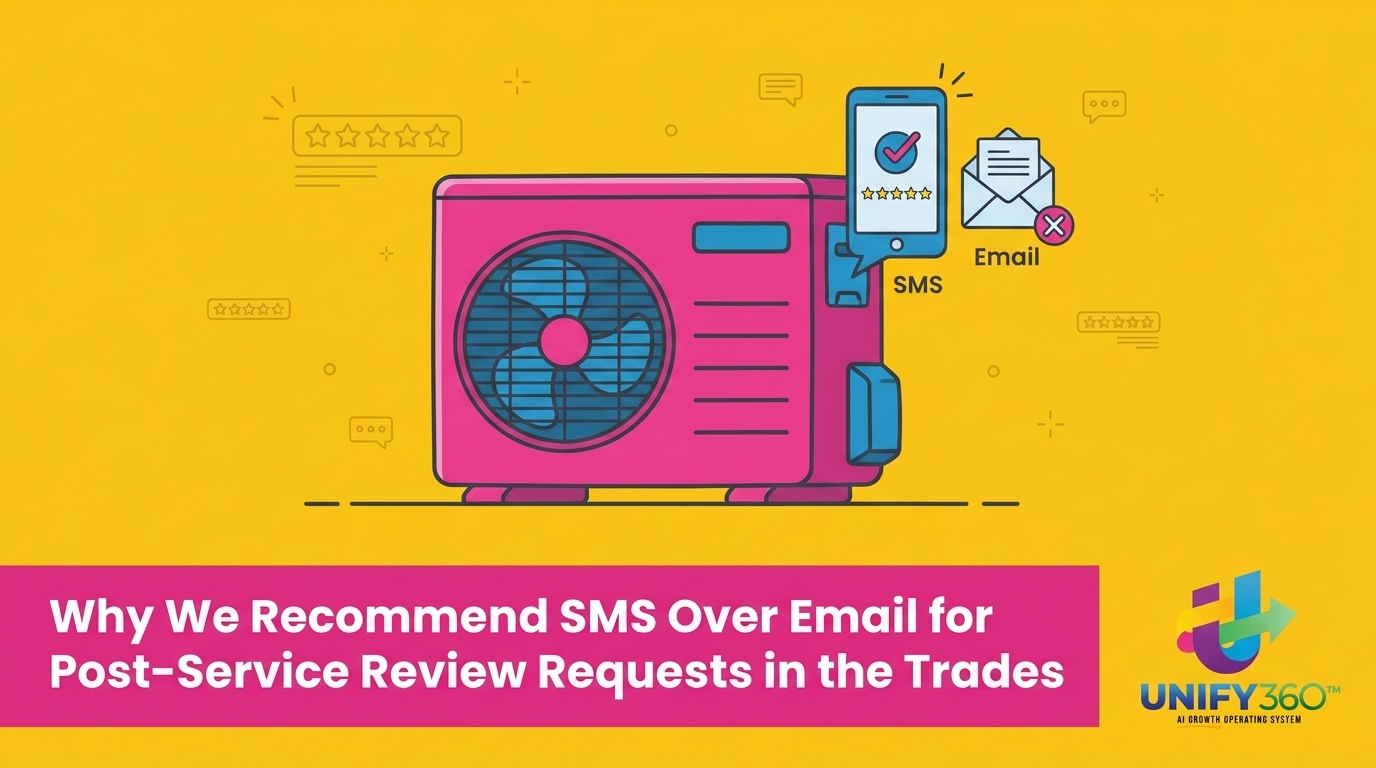
Your technicians are out there delivering five-star service—whether they just swapped out a failing 2006-era 40-gallon water heater or repaired a complex ductless mini-split—but your online reputation does not reflect the hard work happening in the field. Understanding why we recommend SMS over email for post-service review requests in the trades comes down to a simple, frustrating reality: the modern email inbox is actively working against your business. Many HVAC and plumbing contractors run exceptional operations, yet they struggle to generate a steady stream of customer reviews. The disconnect rarely has anything to do with the quality of the repair or installation. Instead, the primary culprit is the delivery mechanism you rely on to ask for that crucial feedback.
To capture genuine customer sentiment, contractors must make the decision to abandon traditional email requests in favor of immediate SMS text requests. We know this because our aggregated campaign observations for HVAC and plumbing contractors reveal a stark contrast between how homeowners interact with their email accounts versus their mobile devices. If you want to scale your operations, integrating effective contractor marketing services means upgrading the way you communicate after the job is done.
The modern inbox barrier:
- Algorithmic sorting: Major email providers automatically route business correspondence away from the primary inbox.
- Notification fatigue: Homeowners rarely receive push notifications for promotional or automated emails, meaning your request sits unseen for hours or days.
- Visual clutter: When a customer finally opens their email, your review request is buried beneath dozens of retail promotions, newsletters, and daily digests.
Relying on email to build your local authority means you are leaving your digital reputation entirely up to chance. The service was excellent, the customer was happy, but the friction of the medium prevents that satisfaction from ever reaching your Google Business Profile.
Why Traditional Email Requests Fail After a Service Call
The failure of email as a review generation tool is not a reflection of your specific messaging; it is a structural problem with the medium itself. Over the last decade, email providers like Gmail, Outlook, and Yahoo have fundamentally changed how they handle incoming messages. Their goal is to protect the user’s primary inbox from clutter, which means any message sent from an automated CRM or marketing platform is immediately flagged and categorized.
The Problem: Automated follow-ups are aggressively filtered into “Promotions” or “Other” tabs. Even if your field service software sends a beautifully designed thank-you email the moment a technician closes a ticket for a 16 SEER2 AC installation, the homeowner likely will not receive a notification on their phone. The message silently bypasses their immediate attention and lands in a folder they only check periodically.
The Cause: This filtering leads to dismal engagement metrics. When we look at the comparative open rates between SMS and email across the home services industry, the average email open rate hovers around a mere 20%. That means 80% of your satisfied customers never even see the request. Furthermore, by the time a homeowner checks their email—often hours or even days after the service call—the momentum and urgency of the completed repair have completely vanished. The immediate relief they felt when the air conditioning kicked back on during a sweltering mid-August heatwave has faded into the background of their daily routine.
The Solution: To fix this broken feedback loop, you must bypass the inbox entirely. By shifting to text-based communication, you place your request directly on the screen the customer is already looking at. If you are tired of seeing your five-star efforts yield zero-star visibility, contact us to streamline your review requests and implement a system that actually reaches your customers.
The Psychology of Immediate Relief in HVAC and Plumbing
Home service repairs are rarely casual purchases; they are often highly stressful situations that disrupt a homeowner’s life. Connecting the emotional state of the customer immediately following a repair to the necessity of frictionless SMS is critical for understanding why text messaging dominates review generation.
During peak climate seasons, such as extreme mid-July summer heat in the Sun Belt or deep January winter freezes in the Northeast, HVAC and plumbing contractors handle high-stress emergency calls. When a family has been sweating in an 85-degree house for two days due to a blown dual run capacitor, or when a burst 3/4-inch copper pipe threatens to flood a finished basement, the arrival of your technician is a major event. Customer gratitude is at its absolute peak the exact moment the technician restores comfort and safety to the home. They are thrilled, relieved, and highly motivated to thank the person who solved their crisis.
However, this peak gratitude is highly fleeting. Our aggregated campaign observations for HVAC and plumbing contractors show that the willingness to leave a review drops exponentially with every hour that passes after the technician leaves. Once the house cools down or the water is cleaned up, the homeowner’s brain moves on to the next task: making dinner, picking up the kids, or getting back to work.
Contractors must strike while the iron is hot. You need a channel that requires zero friction to access. An email requires opening an app, navigating to a specific tab, reading a message, clicking a link, and then logging into a Google account. An SMS request buzzes in their pocket while the technician is still pulling out of the driveway, capturing that intense, immediate gratitude before they forget.
SMS Cuts Through the Noise: Analyzing the Data
Since the aggressive email filtering algorithm updates introduced between 2021 and 2023, the argument for text messaging is not just based on behavioral theory; it is backed by overwhelming data. When we analyze the comparative open rates between SMS and email, the superiority of text messaging for trade businesses becomes undeniable.
General marketing benchmarks consistently reveal that SMS open rates can reach up to 98%. More importantly, data indicates that 90% of text messages are read within the first three minutes of receipt. Unlike emails, text messages trigger instant lock-screen notifications, guaranteeing visibility. A homeowner cannot ignore a text message the way they ignore a promotional email; the notification sits on their screen until it is acknowledged.
| Metric | Traditional Email Requests | SMS / Text Requests |
|---|---|---|
| Average Open Rate | ~20% | Up to 98% |
| Read Time | Hours to days | 90% within 3 minutes |
| Notification Style | Silent, sorted into tabs | Lock-screen push notification |
| Friction to Action | High (requires app navigation) | Low (one-tap native access) |
The Mobile-First Advantage
The conversion rate from open to actual review submission is significantly higher when the link is tapped directly on a mobile device. Homeowners are already using their smartphones to manage their entire day. When they receive an SMS review request, clicking the link opens Google Maps or their native browser.
Because they are using their personal smartphone, they are almost always already logged into their Google or Facebook accounts. This eliminates the single biggest hurdle in review generation: the login screen. By removing the need to remember a password, SMS clears the path for the customer to leave a five-star rating in under thirty seconds.

Operational Integration: Capturing Reviews from the Driveway
A successful review strategy must fit seamlessly into the actual workflow of a field technician. Review generation should never add administrative burden to your office staff or require technicians to manually text customers from their personal phones. Based on Unify360’s direct observation of open rates and our specialized focus on the unique operational realities of HVAC and plumbing contractors, we see these high conversion results specifically because we understand how techs operate in the field.
Here is how SMS requests can be automated to trigger exactly when the customer is most primed to respond:
- The repair is completed: The technician finishes the physical work, tests the newly installed 96% AFUE furnace or clears the stubborn mainline clog, and walks the homeowner through the resolution.
- The invoice is closed: The technician returns to their van or stands in the driveway and closes out the job ticket on their tablet using your field service management software.
- The automated trigger: Closing the ticket automatically communicates with your review generation platform via API, instantly queuing the SMS message.
- The immediate delivery: Before the technician has even put their vehicle in drive, the homeowner’s phone buzzes with a personalized text message thanking them for their business and providing a direct link to review the service.
This operational timing ensures the request arrives exactly when the customer is experiencing peak relief. Our aggregated campaign observations for HVAC and plumbing contractors confirm that this specific “driveway moment” yields the highest possible conversion rate from a completed job to a published public review.
Navigating Compliance and Best Practices for Trade Businesses
While the benefits of text messaging are clear, trade businesses must address the regulatory and strategic considerations of using SMS for B2C communication. Understanding basic Telephone Consumer Protection Act (TCPA) compliance, especially with the strict 10DLC messaging registration requirements implemented in 2023, is essential for any automated follow-up system. Customers must have opted into communication, and your system must always provide a clear way to opt out (such as replying “STOP”).
Beyond compliance, the actual text of the message dictates your success rate. The most effective SMS copy is brief, personal, and direct. Homeowners do not want to read a paragraph of corporate marketing speak via text. Keep the message focused entirely on their experience.
Key best practices for SMS review requests:
- Include the technician’s name: Personalization drastically improves conversion rates. A text that says, “Thanks for choosing us! How did Mike do today?” performs significantly better than a generic company message.
- Keep it under 160 characters: Ensure your message fits into a single, easily readable text block without being broken up by the carrier.
- Provide a single, clear link: Do not ask them to choose between five different review platforms. Direct them straight to the platform that matters most to your local SEO (usually your Google Business Profile).
By following these best practices, grounded in aggregated campaign observations for HVAC and plumbing contractors, you ensure your messages are welcomed rather than viewed as spam.
Frequently Asked Questions
Why is SMS better than email for customer reviews?
SMS is better than email for customer reviews because it bypasses the aggressive spam and promotional filters used by modern email providers. Text messages trigger an immediate push notification on the customer’s phone, resulting in open rates of up to 98%. Because the message is seen instantly, it captures the customer’s gratitude right after a service call, rather than hours or days later when an email might finally be read.
How do contractors ask for reviews via text message?
Contractors ask for reviews via text message by integrating their field service management software with an automated review platform. When a technician closes out an invoice on their tablet, the system automatically triggers a short, personalized text message to the homeowner. This message typically thanks the customer for their business, mentions the technician by name, and includes a direct link to the company’s Google Business Profile.
What is the success rate of SMS vs email for home services?
The success rate of SMS heavily outperforms email in the home services industry. Data shows that email open rates typically sit around 20%, with many messages lost to the “Promotions” tab. In contrast, SMS messages boast open rates near 98%, with 90% of those messages being read within the first three minutes of delivery, leading to significantly higher review completion rates.
Is text messaging better than email for business communication?
Text messaging is generally better than email for urgent, action-oriented business communication like appointment reminders, arrival notifications, and immediate post-service review requests. Email remains useful for long-form communication, sending detailed invoices, or sharing seasonal newsletters. However, when you need a customer to take a quick action on their mobile device, SMS provides far less friction.
How soon after a service call should I send an SMS review request?
You should send an SMS review request immediately after the service call is completed and the invoice is closed. Whether you just completed a routine October furnace tune-up or an emergency midnight pipe repair, the ideal timing is while the technician is still packing up their van or pulling out of the driveway. This captures the homeowner’s peak emotional relief and gratitude before they get distracted by their daily routine.
Do I need special software to automate SMS review requests for my plumbing business?
Yes, you need specialized review generation software that integrates with your existing dispatch or CRM system to automate the process seamlessly. Attempting to manage SMS requests manually from a personal device is inefficient, difficult to track, and hard to keep compliant with communication regulations. Automated platforms ensure the right message goes out at the exact right time without adding extra work for your office staff.
The short answer is that the days of relying on passive emails to build your online reputation are over. By shifting your strategy to automated, perfectly timed SMS requests, you bypass the inbox entirely and connect with your customers exactly when they are most grateful for your work. Understanding exactly why your current email strategy is failing is the first step; making the switch to text messaging will finally give you the confidence that your five-star field work will yield a high volume of legitimate, visible customer reviews.