


Cracking the Code of Customer Sentiment to Build a Permanent Competitive Advantage
In the home service industry, we often talk about reviews as “marketing assets” or “SEO signals.” We look at them as numbers on a dashboard or stars on a map. But if you want to truly dominate your local market, you have to look deeper. You have to understand the psychology behind the click.
Why does one homeowner spend ten minutes writing a glowing three-paragraph testimonial about a furnace repair, while another homeowner—who was equally satisfied—never even opens your follow-up email? Why do people feel a “moral obligation” to report a bad experience, but often feel “too busy” to celebrate a good one?
Understanding the psychological triggers of online feedback is the difference between a business that “gets lucky” with reviews and a business that builds a Reputation Machine. At Unify360, we’ve built our platform around these human behaviors. By using AI to align with customer psychology, we turn “gratitude” into “growth.”
1. The Reciprocity Principle: The “Window of Gratitude”
One of the most powerful forces in human psychology is Reciprocity. When someone does something meaningful for us, we feel an innate, biological urge to give something back.
In home services, this urge is at its peak the moment the problem is solved. When a plumber stops a massive leak, or a roofer fixes a hole before a storm, the homeowner feels an overwhelming sense of relief. That relief translates into a “debt of gratitude.”
However, this “Window of Gratitude” is incredibly small. As hours turn into days, the “Peak Relief” fades into “Normalcy.” By the time the invoice arrives three days later, the homeowner isn’t thinking about how you saved their basement; they’re thinking about the $400 they’re spending.
The Unify360 Strategy: Our AI Reviews system leverages the Reciprocity Principle by automating the “Ask” in real-time. By sending a text message the second the tech hits “Job Complete,” we catch the customer while the emotional “debt” is still fresh. Because it’s a text—the most personal and immediate digital channel—the customer feels a direct connection to the person who just helped them.
2. The Path of Least Resistance: Overcoming “Cognitive Friction”
Most people are “Review Lazy.” It’s not that they don’t want to help; it’s that the “Cognitive Friction” of leaving a review is too high.
- “Where do I go?” * “Do I have to log in?” * “What should I write?”
If a customer has to think too hard, they stop. This is why “Email Surveys” have such low response rates. They feel like homework.
The AI Solution: Unify360 removes every ounce of friction. We don’t send them to a landing page with more options; we send a direct link to the Google Review box. But more importantly, our AI-assisted prompts can help guide the customer. When a customer knows that their review will be seen and responded to by a professional AI that values their input, the “Social Reward” of leaving that review increases. We turn a “chore” into a “contribution.”
3. Social Validation: The “Echo Chamber” Effect
Psychologically, humans are “socially proofed” creatures. We look to the tribe to decide what is safe and what is high-quality. This is known as Social Validation. When a homeowner sees that you have 400 reviews and that you—the owner—have responded to every single one, they aren’t just seeing a high score. They are seeing a Community Conversation. How AI Auto-Replies Trigger This: When Unify360’s AI Auto-Reply responds to a review, it’s doing more than just saying thank you. It is validating the customer’s choice to leave feedback. When other potential customers see this interaction, they think, “If I leave a review for this company, they will actually read it and appreciate it.” This creates a “Virtuous Cycle” where engagement breeds more engagement. You aren’t just collecting stars; you’re building a clubhouse where your customers want to be seen.
4. The “Peak-End” Rule: Finishing Strong
Psychologist Daniel Kahneman famously identified the Peak-End Rule: people judge an experience largely based on how they felt at its peak (the most intense point) and at its end, rather than the total sum of the experience.
In a service call, the “Peak” is the repair. The “End” is the communication after the tech leaves. If the tech leaves and the customer hears nothing but a bill, the “End” is cold and transactional.
Unify360’s Role in the “End”: By following up with a friendly, AI-driven text message asking for feedback, you are extending the “End” of the experience into a positive, appreciative interaction. You are ensuring that the final memory the customer has of your business is one of connection and care, not just a credit card transaction. This dramatically increases the likelihood of a 5-star rating.
5. Cognitive Dissonance: Why People Defend Their Choices
Once a person leaves a 5-star review for your company, they become a “Brand Advocate” due to Cognitive Dissonance. We want our actions to align with our beliefs. By publicly stating, “This is the best electrician in town,” the customer has mentally committed to that belief. They are now significantly more likely to hire you again and to defend your company to their neighbors.
The Power of AI Social: When Unify360 takes that review and turns it into a branded social media post, and the customer sees their own words being celebrated by your brand, that psychological bond is sealed. You have moved from being a “service provider” to a “partner.”
6. Managing the “Vigilante” Psychology (Negative Reviews)
Why do people leave 1-star reviews? Usually, it’s not because the repair failed; it’s because they feel disrespected or ignored. This is “Vigilante Psychology”—the need to “punish” a business for a perceived injustice.
A 1-star review is a cry for attention. If you ignore it, the “Vigilante” gets louder.
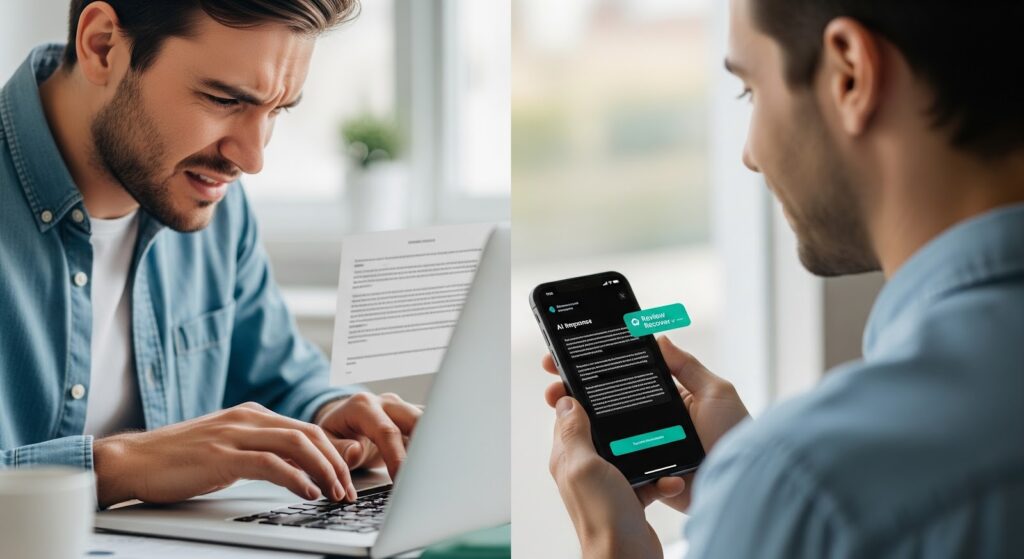
The AI Buffer: Unify360’s AI-driven alerts ensure that a negative review never sits unaddressed. By providing an immediate, professional, and de-escalating response through our AI Auto-Reply system, you “disarm” the vigilante. You show them (and everyone else watching) that you are listening. Often, a customer who feels “heard” through a prompt, professional response will actually go back and change their 1-star to a 4-star. That is the ultimate “Recovery” psychology.
7. The “Halo Effect”: Beyond the Map Pack
Finally, understand the Halo Effect. When a customer sees your 5-star reputation, they subconsciously assume everything else about your business is superior—your prices are fair, your techs are safer, and your equipment is better.
Your reputation creates a “Halo” that makes every other part of your marketing more effective. Your Google Ads get more clicks. Your Facebook posts get more likes. Your “Zero-Friction” booking leads to more sales.
Mastering the Human Element
Technology is often seen as cold and distant, but at Unify360, we use AI to make your business more human. We use automation to honor the “Window of Gratitude,” to remove “Cognitive Friction,” and to provide the “Social Validation” that your customers crave.
By understanding the psychology of why people review, you stop chasing stars and start building a culture of excellence. You stop being a “contractor” and start being a “community staple.”
Are you ready to use the power of psychology to grow your business? Experience the platform that turns customer sentiment into your greatest asset.
Book your free demo with Unify360 today and start building your Reputation Machine!